
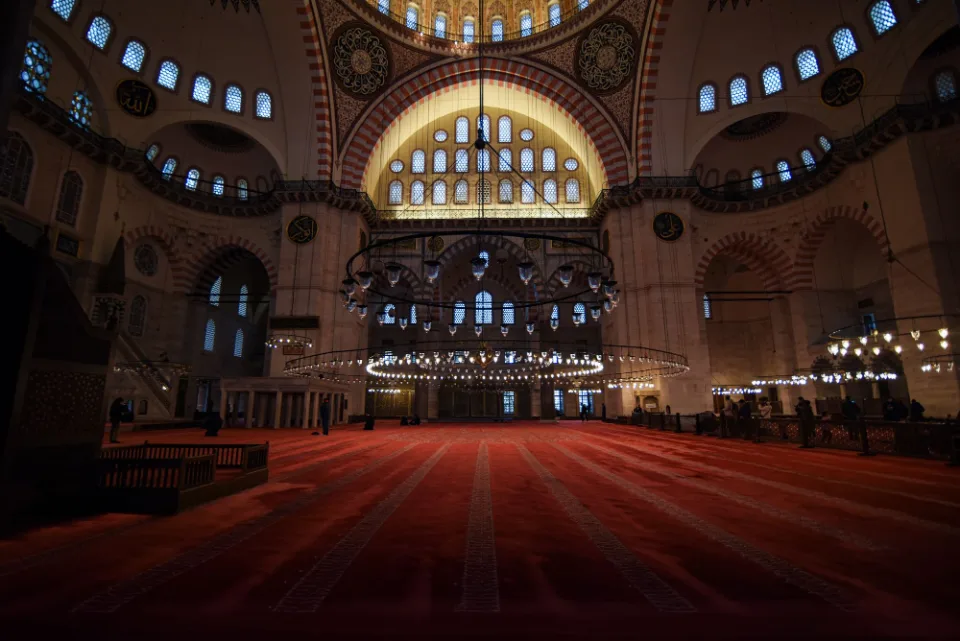
Jumu'ah, the Friday prayer, is two rak'ahs prayed in congregation after a short sermon, and it takes the place of Dhuhr on Fridays. You go to the mosque around the start of Dhuhr time, listen to the sermon (the khutbah), then pray two rak'ahs behind the imam. The whole thing often takes thirty to forty-five minutes.
If you've never been, it can feel daunting: a full hall, a sermon partly in Arabic, everyone seeming to know when to stand. It's simpler than it looks, and you'll be one of many people there for their first or fiftieth time.
Why Friday matters
Allah tells the believers to drop what they're doing when the call to Friday prayer is made:
يَـٰٓأَيُّهَا ٱلَّذِينَ ءَامَنُوٓا۟ إِذَا نُودِىَ لِلصَّلَوٰةِ مِن يَوْمِ ٱلْجُمُعَةِ فَٱسْعَوْا۟ إِلَىٰ ذِكْرِ ٱللَّهِ وَذَرُوا۟ ٱلْبَيْعَۚ ذَٰلِكُمْ خَيْرٌ لَّكُمْ إِن كُنتُمْ تَعْلَمُونَ ٩
9O you who have believed, when [the adhān] is called for the prayer on the day of Jumuʿah [Friday], then proceed to the remembrance of Allāh and leave trade. That is better for you, if you only knew.
فَإِذَا قُضِيَتِ ٱلصَّلَوٰةُ فَٱنتَشِرُوا۟ فِى ٱلْأَرْضِ وَٱبْتَغُوا۟ مِن فَضْلِ ٱللَّهِ وَٱذْكُرُوا۟ ٱللَّهَ كَثِيرًا لَّعَلَّكُمْ تُفْلِحُونَ ١٠
10And when the prayer has been concluded, disperse within the land and seek from the bounty of Allāh, and remember Allāh often that you may succeed.
Translation: Saheeh International. Recitation: Mishary al-Afasy.
Notice the second ayah: once the prayer's over, go back to work. Jumu'ah isn't a day off. And Friday itself is special:
The best day on which the sun has risen is Friday; on it Adam was created, on it he was made to enter Paradise, on it he. was expelled from it.
Narrated by Abu Hurairah. Shortened.
Who has to attend
Jumu'ah is required for adult Muslim men who are healthy and not travelling. The Prophet ﷺ named four groups it isn't required of:
The Friday prayer in congregation is a necessary duty for every Muslim, with four exceptions; a slave, a woman, a boy, and a sick person.
Narrated by Tariq ibn Shihab. Graded sahih by al-Albani. Shortened.
Travellers are also excused, according to the majority of scholars. If you're excused and don't go, you pray Dhuhr as normal (four rak'ahs).
Women and Jumu'ah
Women don't have to attend, but they're welcome, and the Prophet ﷺ told men not to stop them going to the mosque (Sahih al-Bukhari 900). If a woman prays Jumu'ah with the congregation, it counts in place of Dhuhr and she doesn't pray Dhuhr as well. Many mosques in the UK, US, Canada and Australia have a women's area; check the mosque's website or call ahead.
Before you go
- Take a ghusl. The Prophet ﷺ said anyone coming to Jumu'ah should bathe. Most scholars treat it as a strong sunnah, not a condition of the prayer.
- Make wudu and wear clean clothes, your better ones if you can. Men can wear a pleasant scent.
- Go early. The earlier you arrive, the greater the reward (Sahih al-Bukhari 881 compares the earliest arrival to sacrificing a camel), and the easier it is to find space and parking.
- Work: Jumu'ah falls in Friday lunchtime. Many people in the UK, US, Canada and Australia arrange a longer lunch break or flexible hours for it; ask your manager early.
Anyone of you attending the Friday (prayers) should take a bath.
Narrated by 'Abdullah ibn 'Umar.
At the mosque, step by step
- Arrive and pray two rak'ahs if you have time before the imam starts. This is the greeting of the mosque.
- Sit and wait. Read Quran, make du'a or sit in silence. Don't step over people to get to the front; the Prophet ﷺ told a man doing that during the khutbah to sit down because he was bothering people (Sunan Abi Dawud 1118, sahih per al-Albani).
- The adhan. In many mosques the imam sits on the minbar (pulpit) and the adhan is called.
- The first khutbah. The imam stands and gives the sermon. In many mosques in English-speaking countries most of it is in English, with Arabic at the start and end.
- A short sitting. The imam sits briefly between two khutbahs. Many people make a quiet du'a here.
- The second khutbah, usually shorter, ending with du'a.
- The iqamah is called. Stand, fill the rows, shoulder to shoulder.
- Two rak'ahs behind the imam. He recites aloud. You follow his movements, say Allahu akbar with each one, and stay quiet while he recites.
- After the salam, many people stay for dhikr and then pray sunnah rak'ahs.
Inside the prayer, everything is the same as any other prayer. Our guide to what to say in salah lists the words for each position.
Listening to the khutbah
Once the khutbah starts, you stop talking. Completely. The Prophet ﷺ said even telling someone else to be quiet is wrong:
When the Imam is delivering the Khutba, and you ask your companion to keep quiet and listen, then no doubt you have done an evil act.
Narrated by Abu Hurairah.
Put your phone on silent before you arrive. If it buzzes, leave it. And the reward for doing all this properly is big:
He who took a bath and then came for Jumu'a prayer and then prayed what was fixed for him, then kept silence till the Imam finished the sermon, and then prayed along with him, his sins between that time and the next Friday would be forgiven, and even of three days more.
Narrated by Abu Hurairah.
What's recited in the prayer
The imam can recite any surahs. A common choice comes from the Prophet ﷺ himself:
the Messenger of Allah (ﷺ) used to recite on two 'Ids and in Friday prayer:" Glorify The name of Thy Lord, the Most High" (Surah lxxxvii.), and:" Has there come to thee the news of the overwhelming event" (lxxxviii.).
Narrated by an-Nu'man ibn Bashir. Shortened.
Those are Surah Al-A'la (87) and Surah Al-Ghashiyah (88). Some imams recite Al-Jumu'ah (62) and Al-Munafiqun (63) instead, which Abu Hurairah also heard the Prophet ﷺ recite on Fridays (Sahih Muslim 877a).
Sunnah prayers after Jumu'ah
After the Friday prayer, pray four rak'ahs at the mosque or two at home. Both come from the Prophet ﷺ:
When any one of you observes the Jumu'a prayer (two obligatory rak'ahs in congregation), he should observe four (rak'ahs) afterwards.
Narrated by Abu Hurairah.
He never prayed after Jumua prayer till he departed (from the Mosque), and then he would pray two rak`at at home.
Narrated by 'Abdullah ibn 'Umar. Shortened.
Many people also pray before the khutbah. Schools differ on whether there's a set sunnah before Jumu'ah: the Hanafi school counts four, while others treat it differently. Our article on how many rakats in each prayer has the full picture.
If you miss Jumu'ah
If you miss it, pray Dhuhr instead: four rak'ahs, as on any other day. You can't make up Jumu'ah on your own at home, because it needs a congregation and a khutbah.
Missing it now and then for a real reason, like illness or travel, isn't a sin. Missing it out of laziness is serious, and the warning is clear:
He who leaves the Friday prayer (continuously) for three Friday on account of slackness, Allah will print a stamp on his heart.
Narrated by al-Ja'd ad-Damri. Graded hasan sahih by al-Albani.
The free Salah course includes a lesson on praying with others: joining a row, following the imam, and catching up if you arrive late. It's part of the New Muslim Foundations path. If Friday's your first visit to a mosque since your shahada, our first-week guide has more on finding your people.
Questions people ask
How many rakats is Jummah?
Two fard rak'ahs, prayed in congregation after the khutbah. They replace the four of Dhuhr. Many people pray sunnah rak'ahs before and after.
Why is Jummah only 2 rakats?
The Prophet ﷺ prayed it as two rak'ahs, with the khutbah before it, and every school follows that. It takes the place of Dhuhr on Fridays.
Can I pray Jummah at home?
No. Jumu'ah needs a congregation and a khutbah. If you can't get to one, pray Dhuhr at home as four rak'ahs.
Do women have to pray Jummah?
No. It isn't required of women, but they're welcome to attend. If a woman prays Jumu'ah, it counts instead of Dhuhr.
Can I skip Jummah if I'm travelling?
Most scholars say travellers are excused and pray Dhuhr instead (shortened to two rak'ahs while travelling). Schools differ on what distance counts as travel.
What happens if I miss three Jummahs?
Missing three in a row out of laziness carries a serious warning (Sunan Abi Dawud 1052). If you miss for a valid reason like illness, there's no sin. Repent if you've missed out of carelessness, and go next Friday.