
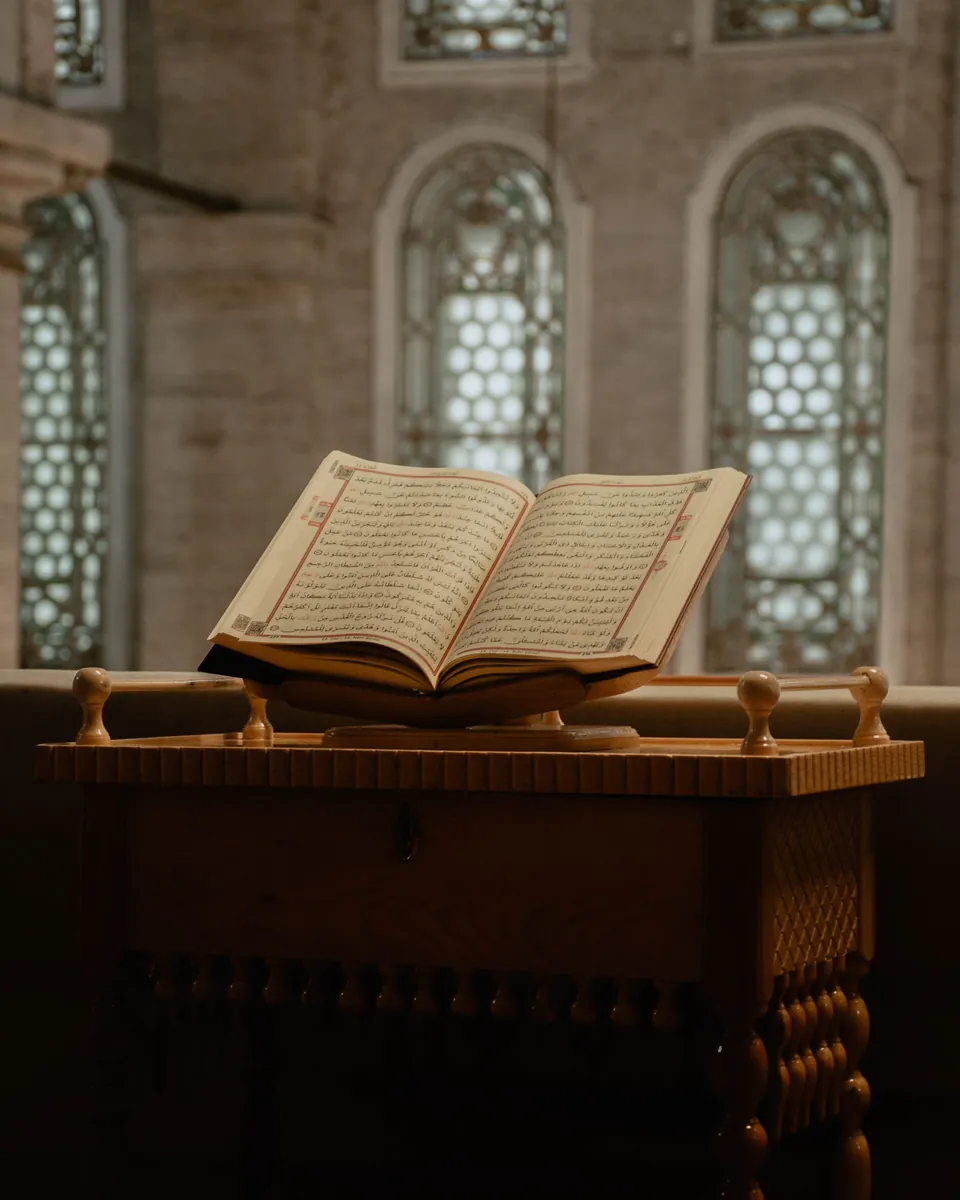
Surah Al-Fatihah ("The Opening") is the first chapter of the Quran: seven short ayat that praise Allah, declare that we worship only Him, and ask Him to guide us to the straight path. In meaning, it's a conversation. The first half is praise of Allah, the middle line is a promise between you and Him, and the last half is a request for guidance, which Allah promises to answer.
Every Muslim recites it in every rak'ah of every prayer, at least seventeen times a day. So it's the part of the Quran you'll say most in your life. Below is the whole surah with transliteration and meaning, then a short explanation of each ayah.
Al-Fatihah in Arabic and English
بِسْمِ ٱللَّهِ ٱلرَّحْمَـٰنِ ٱلرَّحِيمِ ١
1In the name of Allāh, the Entirely Merciful, the Especially Merciful.
ٱلْحَمْدُ لِلَّهِ رَبِّ ٱلْعَـٰلَمِينَ ٢
2[All] praise is [due] to Allāh, Lord of the worlds -
ٱلرَّحْمَـٰنِ ٱلرَّحِيمِ ٣
3The Entirely Merciful, the Especially Merciful,
مَـٰلِكِ يَوْمِ ٱلدِّينِ ٤
4Sovereign of the Day of Recompense.
إِيَّاكَ نَعْبُدُ وَإِيَّاكَ نَسْتَعِينُ ٥
5It is You we worship and You we ask for help.
ٱهْدِنَا ٱلصِّرَٰطَ ٱلْمُسْتَقِيمَ ٦
6Guide us to the straight path -
صِرَٰطَ ٱلَّذِينَ أَنْعَمْتَ عَلَيْهِمْ غَيْرِ ٱلْمَغْضُوبِ عَلَيْهِمْ وَلَا ٱلضَّآلِّينَ ٧
7The path of those upon whom You have bestowed favor, not of those who have earned [Your] anger or of those who are astray.
Translation: Saheeh International. Recitation: Mishary al-Afasy.
Transliteration and meaning, line by line
Transliteration helps you follow along, but it can't show every Arabic sound, so learn the recitation from a teacher or recording as well. The English is the Saheeh International translation.
| Ayah | Transliteration | Meaning |
|---|---|---|
| 1 | Bismillahir-rahmanir-rahim | In the name of Allah, the Entirely Merciful, the Especially Merciful. |
| 2 | Al-hamdu lillahi rabbil-'alamin | [All] praise is [due] to Allah, Lord of the worlds |
| 3 | Ar-rahmanir-rahim | The Entirely Merciful, the Especially Merciful, |
| 4 | Maliki yawmid-din | Sovereign of the Day of Recompense. |
| 5 | Iyyaka na'budu wa iyyaka nasta'in | It is You we worship and You we ask for help. |
| 6 | Ihdinas-siratal-mustaqim | Guide us to the straight path |
| 7 | Siratal-ladhina an'amta 'alayhim, ghayril-maghdubi 'alayhim wa lad-dallin | The path of those upon whom You have bestowed favor, not of those who have earned [Your] anger or of those who are astray. |
The meaning of each ayah
1. In the name of Allah, the Entirely Merciful, the Especially Merciful
You start by naming Allah and two of His names that both come from rahmah, mercy. Ar-Rahman is usually explained as mercy that's vast and reaches all of creation; ar-Rahim as mercy that's constant and given especially to the believers. Before you ask for anything, you remind yourself who you're asking.
2. All praise is due to Allah, Lord of the worlds
Al-hamd is praise and thanks together. "Lord" (Rabb) means the One who creates, owns, provides for and looks after something. Al-'alamin, "the worlds", is everything other than Allah: people, jinn, animals, galaxies.
3. The Entirely Merciful, the Especially Merciful
Mercy is mentioned again straight after "Lord of the worlds". The One who owns everything is first described by His mercy.
4. Sovereign of the Day of Recompense
Yawm ad-din is the Day of Judgement, when every deed is repaid. The surah balances mercy with accountability: hope and awareness side by side.
5. It is You we worship and You we ask for help
This is the center of the surah. In Arabic, "You" comes first (iyyaka), which gives the sense of "You alone". It's a promise that you'll worship no one else, and an admission that you can't even do that without His help. Notice it's "we", not "I": even praying alone, you speak as part of the ummah.
6. Guide us to the straight path
After praising Allah and making the promise, you ask. And the thing you ask for, seventeen times a day, is guidance. Not money or health, though you can ask for those too, but to be shown the right way and kept on it.
7. The path of those You've favored
Allah explains elsewhere who those people are: "the prophets, the steadfast affirmers of truth, the martyrs and the righteous" (4:69). Then you ask not to be among those who earned anger or those who went astray. Ibn Kathir explains in his tafsir that the first knew the truth and didn't follow it, and the second acted without knowledge, and many commentators name the Jews and the Christians as the examples meant. The lesson for us is to pair knowledge with action, so it's a prayer about our own path, not a curse on anyone.
How Allah answers Al-Fatihah in the prayer
This is the hadith that changes how people pray once they know it. The Prophet ﷺ said Allah answers you line by line:
I have divided the prayer into two halves between Me and My servant, and My servant will receive what he asks. When the servant says: Praise be to Allah, the Lord of the universe, Allah the Most High says: My servant has praised Me. And when he (the servant) says: The Most Compassionate, the Merciful, Allah the Most High says: My servant has lauded Me. And when he (the servant) says: Master of the Day of judg- ment, He remarks: My servant has glorified Me.
Narrated by Abu Hurairah, as a hadith qudsi. Shortened.
The hadith goes on: at "It is You we worship and You we ask for help", Allah says, "This is between Me and My servant", and at the last two ayat, "This is for My servant, and My servant will receive what he asks for." Try pausing for a breath at the end of each ayah next time you pray, and remember there's an answer.
Why it's recited in every rak'ah
Whoever does not recite Al-Fatiha in his prayer, his prayer is invalid.
Narrated by 'Ubadah ibn as-Samit.
That's why it's the first surah every new Muslim learns. Scholars differ on details, such as whether someone praying behind an imam recites it in loud prayers, but they agree that it's the heart of the recitation in salah. If you haven't memorized it yet, our guide to the first surahs to learn for salah starts here.
Saying Ameen
At the end of Al-Fatihah you say Ameen, meaning "O Allah, answer". It isn't part of the surah, so it's said after a short pause. In congregation, everyone says it with the imam:
say ameen" when the imam says it and if the ameen of any one of you coincides with that of the angels then all his past sins will be forgiven.
Narrated by Abu Hurairah. Shortened.
Whether you say it aloud or under your breath differs between the schools; follow your mosque.
The names of Al-Fatihah
The hadith give it several names, and each tells you something about it:
- Umm al-Qur'an, "the Mother of the Quran" (Sahih Muslim 395), because it contains the Quran's core themes in brief.
- As-Sab' al-Mathani, "the seven often-repeated" (Sahih al-Bukhari 4474, echoing 15:87), because its seven ayat are repeated in every prayer.
- Fatihat al-Kitab, "the Opening of the Book" (Sahih Muslim 806).
Virtues of Al-Fatihah (authentic only)
It's the greatest surah in the Quran. The Prophet ﷺ promised to teach Abu Sa'id ibn al-Mu'alla the greatest surah before he left the mosque:
Al-Hamdu-Li l-lah Rabbi-l-`alamin (i.e. Praise be to Allah, the Lord of the worlds) which is Al-Sab'a Al-Mathani (i.e. seven repeatedly recited Verses) and the Grand Qur'an which has been given to me.
Narrated by Abu Sa'id ibn al-Mu'alla. Shortened.
It's one of two "lights" no earlier prophet was given. An angel told the Prophet ﷺ to rejoice in Al-Fatihah and the last ayat of Al-Baqarah, and that he'd never recite a letter of them without being given its reward (Sahih Muslim 806).
It was used as ruqyah. A Companion recited Al-Fatihah over a man stung by a scorpion, and he recovered. The Prophet ﷺ approved and asked how he knew it could be used for treatment (Sahih al-Bukhari 5007).
Learning it properly
Al-Fatihah is short, but there are a few sounds in it that English speakers often get wrong, such as the 'ayn in na'budu and the heavy d in ad-dallin. Our free course goes through it line by line: the Arabic, the meaning of each word, and how to recite it correctly in your prayer. You can also listen to it and read it in our Quran reader. Once it's solid, our guide to the meanings of the Juz 'Amma surahs and the Short Surahs for Salah course is the natural next step.
Questions people ask
What is the meaning of Surah Al-Fatihah?
It praises Allah as Lord of the worlds and the Most Merciful, promises to worship Him alone and rely on Him, and asks Him for guidance to the straight path of those He favored.
How many ayat are in Surah Al-Fatihah?
Seven, counting the basmalah as the first, which is how the standard Hafs mushaf numbers it.
Why is Al-Fatihah recited in every prayer?
The Prophet ﷺ said the prayer of someone who doesn't recite Al-Fatihah is invalid (Sahih al-Bukhari 756). It's the core recitation of every rak'ah.
Is Ameen part of Al-Fatihah?
No. It means "O Allah, answer" and is said after the surah, with the imam in congregation.
What does "Iyyaka na'budu wa iyyaka nasta'in" mean?
"It is You we worship and You we ask for help." Putting "You" first in the Arabic gives the sense of "You alone".
Who are "those who earned anger" and "those who went astray"?
Commentators explain them as those who knew the truth and didn't follow it, and those who acted without knowledge, often citing the Jews and Christians as examples. The lesson is to combine knowledge with action.