
In Ramadan you don't eat, drink or have sex from dawn until sunset, every day for the month, and you eat at night. That's the fast. Around it sit the extra prayers, the Quran, the late dinners with friends and the very early breakfasts. For a first Ramadan, the fast itself is what's required; the rest you join as much as you can.
Ramadan 2027 is expected to begin around 8 February, depending on the sighting of the moon. In the UK, Canada and the northern US that means fairly short winter fasts, which makes it a kind first Ramadan. In Australia it falls in late summer, with longer days.
Why Muslims fast
Fasting in Ramadan is one of the five pillars of Islam, and the Quran gives the reason in the same breath as the command:
يَـٰٓأَيُّهَا ٱلَّذِينَ ءَامَنُوا۟ كُتِبَ عَلَيْكُمُ ٱلصِّيَامُ كَمَا كُتِبَ عَلَى ٱلَّذِينَ مِن قَبْلِكُمْ لَعَلَّكُمْ تَتَّقُونَ ١٨٣
O you who have believed, decreed upon you is fasting as it was decreed upon those before you that you may become righteous -
Translation: Saheeh International. Recitation: Mishary al-Afasy.
The goal is taqwa, being mindful of Allah. You go without food you'd normally have no trouble getting, because Allah asked, and the hunger reminds you of Him all day. The month is also when the Quran was first revealed:
شَهْرُ رَمَضَانَ ٱلَّذِىٓ أُنزِلَ فِيهِ ٱلْقُرْءَانُ هُدًى لِّلنَّاسِ وَبَيِّنَـٰتٍ مِّنَ ٱلْهُدَىٰ وَٱلْفُرْقَانِۚ فَمَن شَهِدَ مِنكُمُ ٱلشَّهْرَ فَلْيَصُمْهُۖ وَمَن كَانَ مَرِيضًا أَوْ عَلَىٰ سَفَرٍ فَعِدَّةٌ مِّنْ أَيَّامٍ أُخَرَۗ يُرِيدُ ٱللَّهُ بِكُمُ ٱلْيُسْرَ وَلَا يُرِيدُ بِكُمُ ٱلْعُسْرَ وَلِتُكْمِلُوا۟ ٱلْعِدَّةَ وَلِتُكَبِّرُوا۟ ٱللَّهَ عَلَىٰ مَا هَدَىٰكُمْ وَلَعَلَّكُمْ تَشْكُرُونَ ١٨٥
The month of Ramaḍān [is that] in which was revealed the Qur’ān, a guidance for the people and clear proofs of guidance and criterion. So whoever sights [the crescent of] the month, let him fast it; and whoever is ill or on a journey - then an equal number of other days. Allāh intends for you ease and does not intend for you hardship and [wants] for you to complete the period and to glorify Allāh for that [to] which He has guided you; and perhaps you will be grateful.
Translation: Saheeh International. Recitation: Mishary al-Afasy.
And the reward is big, especially for someone fasting it for the first time with real belief:
Whoever observes fasts during the month of Ramadan out of sincere faith, and hoping to attain Allah's rewards, then all his past sins will be forgiven.
Narrated by Abu Hurairah.
Who has to fast, and who doesn't
Every adult Muslim who is healthy and not travelling has to fast. The Quran excuses people who are ill or travelling, and they make the days up later:
أَيَّامًا مَّعْدُودَٰتٍۚ فَمَن كَانَ مِنكُم مَّرِيضًا أَوْ عَلَىٰ سَفَرٍ فَعِدَّةٌ مِّنْ أَيَّامٍ أُخَرَۚ وَعَلَى ٱلَّذِينَ يُطِيقُونَهُۥ فِدْيَةٌ طَعَامُ مِسْكِينٍۖ فَمَن تَطَوَّعَ خَيْرًا فَهُوَ خَيْرٌ لَّهُۥۚ وَأَن تَصُومُوا۟ خَيْرٌ لَّكُمْۖ إِن كُنتُمْ تَعْلَمُونَ ١٨٤
[Fasting for] a limited number of days. So whoever among you is ill or on a journey [during them] - then an equal number of other days [are to be made up]. And upon those who are able [to fast, but with hardship] - a ransom [as substitute] of feeding a poor person [each day]. And whoever volunteers good [i.e., excess] - it is better for him. But to fast is best for you, if you only knew.
Translation: Saheeh International. Recitation: Mishary al-Afasy.
- Illness: if fasting would harm you or slow your recovery, you don't fast, and you make up the days later. If you have a long-term condition or take medication at set times, talk to your doctor and your imam before Ramadan, not on the first morning.
- Travel: you may break the fast and make it up. Schools differ on what counts as travel.
- Periods and postnatal bleeding: you don't fast, and you make up the days later. See your period in Islam.
- Pregnancy and breastfeeding: a woman who fears for herself or her baby may not fast. Scholars differ on whether she makes the days up, feeds a poor person for each day, or both.
- Old age or permanent illness: someone who can't fast now and won't be able to later feeds a poor person for each day instead. This is called fidyah.
A fasting day, start to finish
- Suhoor before dawn. Eat and drink before Fajr starts. Don't skip it to sleep in. The Prophet ﷺ said there's blessing in it.
- The intention. Intend in your heart to fast tomorrow. You don't need to say anything aloud; getting up for suhoor is an intention in itself. Schools differ on whether one intention at the start of Ramadan covers the whole month.
- The day. No food, drink, smoking or sex until sunset. Pray as usual. Work, study and go about your day.
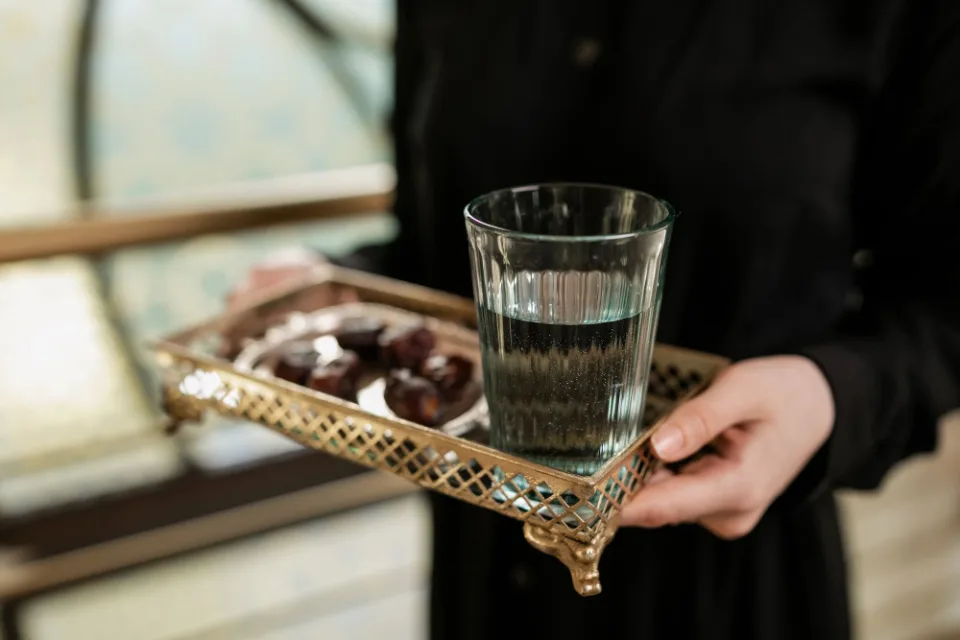
- Iftar at sunset. Break your fast when the sun sets, at Maghrib. Many people start with dates and water. Don't delay it.
- The night. Pray Maghrib and Isha, and join the night prayer (taraweeh) if you can. Eat and drink freely until the next dawn.
Take Suhur as there is a blessing in it.
Narrated by Anas ibn Malik.
The people will remain on the right path as long as they hasten the breaking of the fast.
Narrated by Sahl ibn Sa'd.
The exact times change every day. Our prayer times page gives Fajr and Maghrib for your city, and the Ramadan guide pulls the month together in one place.
What breaks a fast, and what doesn't
Eating, drinking or having sex on purpose during the day breaks the fast, and so does deliberately making yourself vomit. Smoking breaks it too.
Plenty of things don't. If you forget you're fasting and eat or drink, carry on: your fast is fine.
If somebody eats or drinks forgetfully then he should complete his fast, for what he has eaten or drunk, has been given to him by Allah.
Narrated by Abu Hurairah.
Most scholars also say these don't break your fast: brushing your teeth (without swallowing), a shower or swim (without swallowing water), swallowing your own saliva, a blood test, and vomiting that you didn't cause. Things like eye drops, injections and inhalers are discussed in more detail by scholars, and opinions vary, so ask before Ramadan if you need them.
Fasting is more than not eating
A fast where you snap at everyone and lie your way through the day misses the point. The Prophet ﷺ was blunt about it:
Whoever does not give up forged speech and evil actions, Allah is not in need of his leaving his food and drink (i.e. Allah will not accept his fasting.)
Narrated by Abu Hurairah.
So the month is also about your tongue and your temper. If someone provokes you, the Sunnah is to say, "I'm fasting," and leave it (Sahih al-Bukhari 1904).
If you take your shahada during Ramadan
Welcome. You start fasting from the next day. You don't make up the days of Ramadan before your shahada. For the day you actually became Muslim, scholars differ on whether you should hold back from food for the rest of it, and on whether it needs making up. Ask your imam; it's one day, and either way you're starting well.
The nights: taraweeh and the last ten
After Isha, mosques pray taraweeh, a long night prayer in Ramadan. It's a sunnah, not a duty. If you can't follow the long recitation yet, stand at the back, pray what you can, and leave when you need to. Nobody's counting.
The last ten nights are the most important of the year. One of them is Laylat al-Qadr, the Night of Decree, which the Quran calls better than a thousand months (97:3). Do a little extra in those nights: more du'a, more Quran, a bit more prayer. Du'a in your own words and your own language is fine.
Work, college and family
- Tell your manager or tutor before Ramadan if it'll affect you. Many workplaces in the UK, US, Canada and Australia already know about it. Ask to take a later lunch or leave a little early to break your fast, rather than asking for less work.
- Plan your sleep. Early suhoor plus late nights is the real challenge, not the hunger. A short nap after work helps a lot.
- Non-Muslim family: you can still eat with them in the evening. If they invite you to lunch, a polite "I'm fasting, can we do dinner instead?" is usually enough.
- Find an iftar. Most mosques host open iftars, and new Muslims are welcomed. It's one of the easiest ways to meet people.
Eid and zakat al-fitr
Ramadan ends with Eid al-Fitr. Before the Eid prayer, every Muslim pays a small charity for themselves and their dependants, zakat al-fitr:
Allah's Messenger (ﷺ) enjoined the payment of one Sa' of dates or one Sa' of barley as Zakat-ul-Fitr on every Muslim slave or free, male or female, young or old, and he ordered that it be paid before the people went out to offer the `Id prayer.
Narrated by Ibn 'Umar. Shortened.
Your local mosque will tell you this year's amount per person and how they collect it. The schools differ on whether it can be paid in money or has to be food. Then go to the Eid prayer in the morning. It's a joyful day, and it's the end of your first Ramadan.
The free-to-start course Fasting & Zakat walks through your first fast from suhoor to iftar, who's excused, making up missed days and fidyah, taraweeh, the last ten nights and zakat al-fitr, and ends with a lesson on planning your first Ramadan. If you like to plan on paper, Your Ramadan Planner helps you learn the fast before the month and track each day.
Questions people ask
Do new Muslims have to fast in Ramadan?
Yes, if you're an adult, healthy and not travelling. You start from the day after your shahada. If fasting would harm your health, you're excused like anyone else.
What must Muslims not do during Ramadan?
While fasting, from dawn to sunset: no eating, drinking, smoking or sex. All month: avoid lying, arguing and anything else that's wrong at any time; the fast is meant to make you more careful, not just hungry.
Can I brush my teeth while fasting?
Yes. Most scholars say brushing is fine as long as you don't swallow the water or toothpaste. Some prefer avoiding toothpaste to be careful.
What happens if I eat by accident?
If you forgot you were fasting, carry on fasting. Your fast is still valid (Sahih al-Bukhari 1933).
Is taraweeh compulsory?
No. It's a sunnah. Pray what you can, at the mosque or at home.
How hard is fasting in Ramadan?
For many people the first few days are the hardest, mostly because of caffeine, sleep and the early start. After that most people settle into it. A proper suhoor with water and slow-release food makes a big difference.