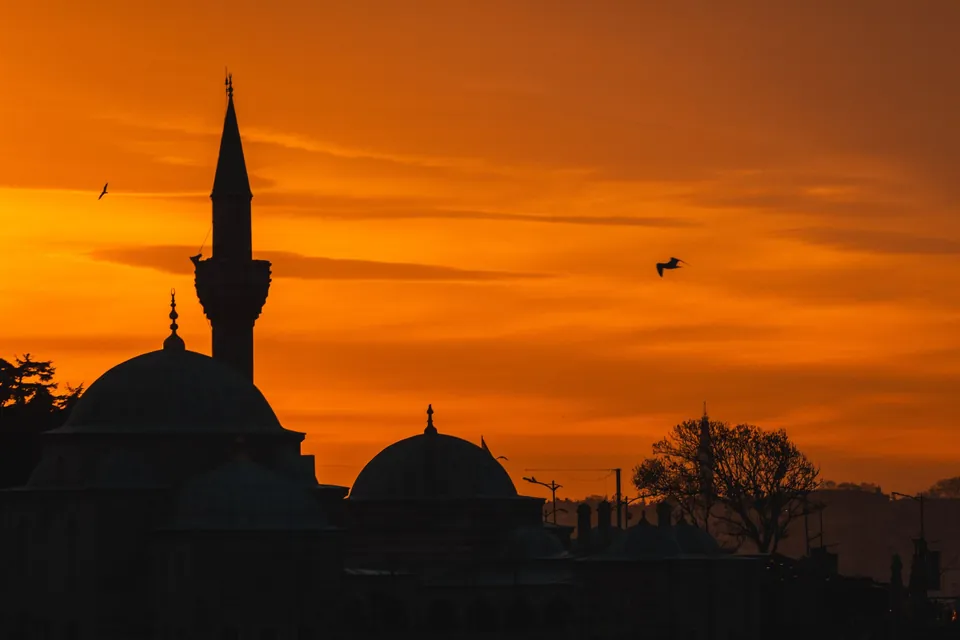


Alhamdulillah (Arabic الحمد لله, al-hamdu lillah) means "all praise is for Allah" or "praise be to Allah". It's both praise and thanks: you're saying that every good thing, and every perfect quality, belongs to Allah. Muslims say it when something good happens, when they're asked how they are, after eating and after sneezing, and even when things go wrong. It's also the first line of Surah Al-Fatihah, so every Muslim says it at least seventeen times a day in prayer.
If you're new, it's probably the phrase you'll use most. Here's what each word means, how to say it, where it comes from, and the hadith that show how much it weighs.
The words, one at a time
| Arabic | Sounds like | Meaning |
|---|---|---|
| الحمد (al-hamdu) | al-HAM-du | the praise, all praise |
| لله (lillah) | lil-LAH | is for Allah, belongs to Allah |
Said out loud, it's al-HAM-du-lil-LAH. The h in hamd is a breathy h from the throat, softer than a cough and stronger than an English h; try it like fogging a mirror. Don't swallow the "du" in the middle: every syllable gets its turn.
You'll also hear hamdulillah, dropping the "al", in quick everyday speech in many Arabic-speaking countries, and hamdullah in some North African speech. They're casual shortenings of the same phrase. In prayer, say the full alhamdulillah.
The "al" at the start matters. It isn't just "praise to Allah" but "the praise", meaning all of it. Whatever anyone praises anywhere, the source of it is Allah.
Hamd: praise and thanks together
English has two words, praise and thanks. Arabic has hamd and shukr. Ibn Kathir explains the difference in his commentary on Al-Fatihah: hamd is more general, because it praises someone both for what they are and for what they've done, while thanks (shukr) is only for what was done. So alhamdulillah means you praise Allah for His favors to you, and also for who He is, even on a day when you can't think of a single thing that went right.
Where it comes from: Al-Fatihah
The Quran's first surah opens, right after the basmalah, with these words:
ٱلْحَمْدُ لِلَّهِ رَبِّ ٱلْعَـٰلَمِينَ ٢
[All] praise is [due] to Allāh, Lord of the worlds -
Translation: Saheeh International. Recitation: Mishary al-Afasy.
"Lord of the worlds": not only your Lord, or the Lord of Muslims, but the Lord of everything that exists. Ibn Kathir reports from Ibn 'Abbas that when a servant says alhamdulillah, Allah says, "My servant has praised Me." Our page on the meaning of Surah Al-Fatihah goes through the rest of the surah line by line.
The phrase comes back again and again in the Quran. Several surahs open with it, and the Quran says the last call of the people of Paradise will be "Praise to Allah, Lord of the worlds!" (10:10).
What it weighs
The Prophet ﷺ said:
Cleanliness is half of faith and al-Hamdu Lillah (all praise and gratitude is for Allah alone) fills the scale, and Subhan Allah (Glory be to Allah) and al-Hamdu Lillah fill up what is between the heavens and the earth
Narrated by Abu Malik al-Ash'ari. Shortened.
"Fills the scale": the scale on the Day of Judgment where deeds are weighed. A two-word sentence fills it. He also called it the best dua:
The best remembrance is: ‘there is none worthy of worship except Allah (Lā ilāha illallāh)’ and the best supplication is: ‘All praise is due to Allah (Al-ḥamdulillāh).’
Narrated by Jabir ibn 'Abdullah. Graded hasan (Darussalam).
Why would praise count as a dua? Scholars explain that when you praise a generous person, you're also asking, without saying so. Thanking Allah for what you have is a way of hoping for more.
When Muslims say Alhamdulillah
When someone asks how you are
Ask a Muslim "How are you?" and the answer is often "Alhamdulillah", or "Good, alhamdulillah." It means "I'm well, and praise is for Allah for it." Some people say it even on a bad day, because whatever the day is like, praise still belongs to Allah.
After eating and drinking
Allah is pleased with His servant who says: Al-Hamdu lillah while taking a morsel of food and while drinking.
Narrated by Anas ibn Malik.
Our post on the dua before and after eating has the longer forms.
After sneezing
This one is a small conversation, and it's lovely once you know it:
If anyone of you sneezes, he should say 'Al-Hamduli l-lah' (Praise be to Allah), and his (Muslim) brother or companion should say to him, 'Yar-hamuka-l-lah' (May Allah bestow his Mercy on you). When the latter says 'Yar-hamuka-llah", the former should say, 'Yahdikumul-lah wa Yuslih balakum' (May Allah give you guidance and improve your condition).
Narrated by Abu Hurayrah.
| Who | Says | Meaning |
|---|---|---|
| The one who sneezes | Alhamdulillah | Praise be to Allah |
| Someone who hears | Yarhamukallah | May Allah have mercy on you |
| The one who sneezed | Yahdikumullah wa yuslihu balakum | May Allah guide you and set your affairs right |
After prayer, and when good news comes
After each obligatory prayer, Muslims say alhamdulillah 33 times, along with subhanAllah and Allahu akbar (Sahih Muslim 597). And any piece of good news, a new job, a safe arrival, a clear test result, gets an alhamdulillah first.
Alhamdulillah 'ala kulli hal: in every situation
Alhamdulillahi 'ala kulli hal means "praise is for Allah in every situation". It's what Muslims say when something is hard, disappointing or painful: a lost job, an illness, a plan that falls apart. It doesn't mean pretending the thing is good. It means trusting that Allah is still praiseworthy, still wise and still caring for you inside it.
The phrase comes from a report in Sunan Ibn Majah (3803), where 'A'ishah says the Prophet ﷺ would say "Al-hamdu lillahi 'ala kulli hal" when he saw something he disliked. Scholars grade it differently: the Darussalam editors shown on sunnah.com grade it weak, while al-Albani graded it hasan (Sahih Ibn Majah 3081) and an-Nawawi called its chain good in al-Adhkar. The meaning, though, is backed by a hadith everyone accepts:
Strange are the ways of a believer for there is good in every affair of his and this is not the case with anyone else except in the case of a believer for if he has an occasion to feel delight, he thanks (God), thus there is a good for him in it, and if he gets into trouble and shows resignation (and endures it patiently), there is a good for him in it.
Narrated by Suhayb.
Good times call for thanks, hard times call for patience, and both are good for the believer. Saying alhamdulillah in a hard moment is a short way of saying both.
How to reply
There's no fixed reply to alhamdulillah on its own, except after a sneeze. If someone tells you "I passed, alhamdulillah," you might say "Mashallah" or "Alhamdulillah" back. If they say it about something difficult, you might say "May Allah make it easy for you."
If you're not Muslim and you hear it
It's a way of saying "thank God" that's also praise. If a Muslim colleague says "alhamdulillah" when you ask about their weekend, they're saying it was good, and thanking God for it.
Start using it today
Alhamdulillah is one of the four phrases the Prophet ﷺ called dearest to Allah, alongside subhanAllah, la ilaha illallah and Allahu akbar (Sahih Muslim 2137). Try answering every "How are you?" with it for a week. You'll be surprised how often you say it, and how it changes the way you think about an ordinary day. Our list of Islamic phrases for everyday use has the rest, and the glossary entry on alhamdulillah is a handy reference.
Since alhamdulillah is the first line of Al-Fatihah, the best place to go deeper is the surah itself. Our free course takes you through it line by line, so you understand what you're saying in every prayer.
Questions people ask
What does Alhamdulillah mean?
"All praise is for Allah" or "praise be to Allah". It's praise and thanks together.
Is it Alhamdulillah, Hamdulillah or Hamdullah?
Alhamdulillah is the full phrase from the Quran. Hamdulillah and hamdullah are casual spoken shortenings. In prayer, say the full alhamdulillah.
What does Alhamdulillah 'ala kulli hal mean?
"Praise is for Allah in every situation." Muslims say it when something hard or disappointing happens.
How do you write Alhamdulillah in Arabic?
الحمد لله. It's the opening of the second verse of Surah Al-Fatihah.
What do you say after someone says Alhamdulillah when they sneeze?
Yarhamukallah, "may Allah have mercy on you". They then reply, yahdikumullah wa yuslihu balakum (Sahih al-Bukhari 6224).
Why do Muslims say Alhamdulillah when asked how they are?
Because whatever their day is like, they want to praise Allah first. It means "I'm well, praise be to Allah".