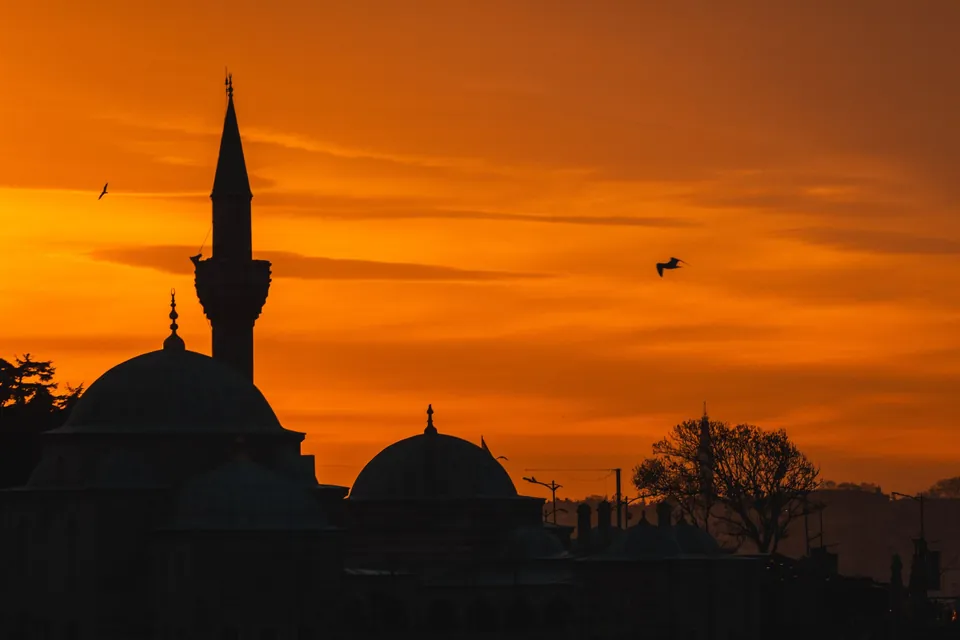
SubhanAllah (Arabic سبحان الله, subhana-llah) means "Glory be to Allah", or more exactly, "Allah is free of every imperfection". When a Muslim says it, they're declaring that Allah is above any flaw, weakness or anything unworthy of Him. It's said in prayer and after prayer, as part of daily remembrance, and in moments of wonder or surprise, when something amazing or unexpected makes you think of how great Allah is.
It's one of the first Arabic phrases most new Muslims pick up, often before they know what it means. Here's the meaning word by word, how to pronounce it, when to say it, and why the Prophet ﷺ called it one of the most beloved words to Allah.
The words, one at a time
| Arabic | Sounds like | Meaning |
|---|---|---|
| سبحان (subhana) | sub-HAA-na | exalted above every flaw; glory |
| الله (Allah) | al-LAH | Allah, God |
Said out loud, it's roughly sub-HAA-nal-LAH. Three things help English speakers:
- The h is a breathy h from the throat, like fogging a mirror. It isn't silent and it isn't a hard "k".
- The aa in the middle is long, like the a in "father".
- The last vowel of subhana runs straight into Allah, so you don't pause between them. That's why you'll see it spelled SubhanAllah, Subhan'Allah, Subhanallah and Subhan Allah. They're all the same phrase.
What it really means: tasbih
The word subhan comes from the root s-b-h, and the act of saying it is called tasbih. Classical Arabic scholars explain it as declaring Allah far removed from anything that doesn't befit Him: any partner, any child, any weakness, any injustice, any need. It's a statement about Allah, not about how you feel. The Quran uses it often in exactly this sense:
سُبْحَـٰنَ رَبِّكَ رَبِّ ٱلْعِزَّةِ عَمَّا يَصِفُونَ ١٨٠
Exalted is your Lord, the Lord of might, above what they describe.
Translation: Saheeh International. Recitation: Mishary al-Afasy.
"Exalted is your Lord... above what they describe." Here the Saheeh International translation renders subhana as "exalted", which is closer to the original than "glory". When you say subhanAllah, you're saying: whatever anyone imagines about Allah that's less than perfect, He's above it.
The Quran also says that everything in creation does this already, in its own way:
تُسَبِّحُ لَهُ ٱلسَّمَـٰوَٰتُ ٱلسَّبْعُ وَٱلْأَرْضُ وَمَن فِيهِنَّۚ وَإِن مِّن شَىْءٍ إِلَّا يُسَبِّحُ بِحَمْدِهِۦ وَلَـٰكِن لَّا تَفْقَهُونَ تَسْبِيحَهُمْۗ إِنَّهُۥ كَانَ حَلِيمًا غَفُورًا ٤٤
The seven heavens and the earth and whatever is in them exalt Him. And there is not a thing except that it exalts [Allāh] by His praise, but you do not understand their [way of] exalting. Indeed, He is ever Forbearing and Forgiving.
Translation: Saheeh International. Recitation: Mishary al-Afasy.
So when a Muslim says subhanAllah, they're joining something the whole of creation is already doing.
When Muslims say SubhanAllah
In wonder and surprise
This is the use you'll hear most in everyday life: a stunning sunset, a baby's tiny fingers, a story of a narrow escape, a coincidence that's too neat to be chance. The Prophet ﷺ used it when he was surprised too. Abu Hurayrah once avoided sitting with him because he was in a state of major impurity and went to bathe first. When he explained, the Prophet ﷺ said:
Subhan Allah! A believer never becomes impure.
Narrated by Abu Hurayrah. Shortened.
So it isn't only for lovely things. It works for anything that makes you stop and think, "How could that be?" and turn the thought toward Allah.
Going downhill, and in prayer
The Companions had a small habit when traveling:
Whenever we went up a place we would say, "Allahu--Akbar (i.e. Allah is Greater)", and whenever we went down a place we would say, "Subhan Allah."
Narrated by Jabir ibn 'Abdullah.
In salah, tasbih is said in bowing (subhana rabbiyal-'azim, "glory be to my Lord, the Most Great") and in prostration (subhana rabbiyal-a'la, "glory be to my Lord, the Most High"). Our guide to what to say in salah lists every phrase in order.
After every prayer: 33 times
After the obligatory prayers, Muslims say subhanAllah 33 times, alhamdulillah 33 times and Allahu akbar 33 times. The reward is huge:
If anyone extols Allah after every prayer thirty-three times, and praises Allah thirty-three times, and declares His Greatness thirty-three times, ninety-nine times in all, and says to complete a hundred:" There is no god but Allah, having no partner with Him, to Him belongs sovereignty and to Him is praise due, and He is Potent over everything," his sins will be forgiven even If these are as abundant as the foam of the sea.
Narrated by Abu Hurayrah.
Most people count on the joints of their fingers. If you'd like help counting, our online tasbih counter works on your phone.
SubhanAllahi wa bihamdihi
A longer form joins tasbih with praise: SubhanAllahi wa bihamdihi, "Glory be to Allah, and praise be to Him". It's short enough to say while you wait for the kettle, and two hadiths in Sahih al-Bukhari show how much it weighs:
Whoever says, 'Subhan Allah wa bihamdihi,' one hundred times a day, will be forgiven all his sins even if they were as much as the foam of the sea.
Narrated by Abu Hurayrah.
There are two expressions which are very easy for the tongue to say, but they are very heavy in the balance and are very dear to The Beneficent (Allah), and they are, 'Subhan Allah Al- `Azim and 'Subhan Allah wa bihamdihi.'
Narrated by Abu Hurayrah. Imam al-Bukhari chose the same hadith to close his whole collection (7563), and it's also in Sahih Muslim (2694).
The second phrase, SubhanAllahil-'Azim, means "Glory be to Allah, the Most Great". When the Prophet ﷺ was asked which words were best, he named subhanAllahi wa bihamdihi, translated in Sahih Muslim as "Hallowed be Allah and praise is due to Him" (Sahih Muslim 2731).
One of the four most beloved words
The Prophet ﷺ named four phrases as the dearest to Allah: subhanAllah, alhamdulillah, la ilaha illallah and Allahu akbar, and said it doesn't matter which you begin with (Sahih Muslim 2137). If you're new, these four are a complete daily dhikr in themselves. You don't need a long list.
How to reply when someone says SubhanAllah
There's no set reply. It's a statement about Allah, not a greeting, so people often just agree or repeat it. If a friend says "SubhanAllah" after you tell them a surprising story, you can say it back, or say "I know, right?" Both are fine.
If you're not Muslim and you hear it
It's an expression of wonder that turns the thought toward God, something like "Glory to God!" in English. If a Muslim friend says it about your news, they're impressed, and you don't need to reply in any particular way.
Start using it today
If you're new to Islam, try this for a week: every time something surprises you, say subhanAllah before anything else. After the five prayers, do the 33, 33 and 33. You'll find you're remembering Allah dozens of times a day without trying. Our list of Islamic phrases for everyday use has the others you'll hear, and the glossary entry on SubhanAllah is a quick reference.
Our free first-week course takes you through the phrases, the prayers and the dhikr that go with them, a step at a time.
Questions people ask
What does SubhanAllah mean in English?
"Glory be to Allah", or "Allah is free of every imperfection". It declares that Allah is above every flaw and anything unworthy of Him.
When do Muslims say SubhanAllah?
In wonder or surprise, when going downhill, in bowing and prostration in salah, 33 times after each obligatory prayer, and as part of daily dhikr.
What is the reward for SubhanAllahi wa bihamdihi?
Whoever says it one hundred times a day will be forgiven his sins even if they were as much as the foam of the sea (Sahih al-Bukhari 6405).
Why do Muslims say SubhanAllah 33 times?
The Prophet ﷺ taught saying subhanAllah, alhamdulillah and Allahu akbar 33 times each after prayer, then la ilaha illallah to complete a hundred, and promised forgiveness of sins (Sahih Muslim 597).
How do you spell SubhanAllah?
SubhanAllah, Subhan'Allah, Subhanallah and Subhan Allah are all common English spellings of سبحان الله. None is more correct.
What's the difference between SubhanAllah and Mashallah?
SubhanAllah glorifies Allah and fits wonder and surprise. Mashallah means "what Allah has willed" and is said about a blessing, often someone else's.