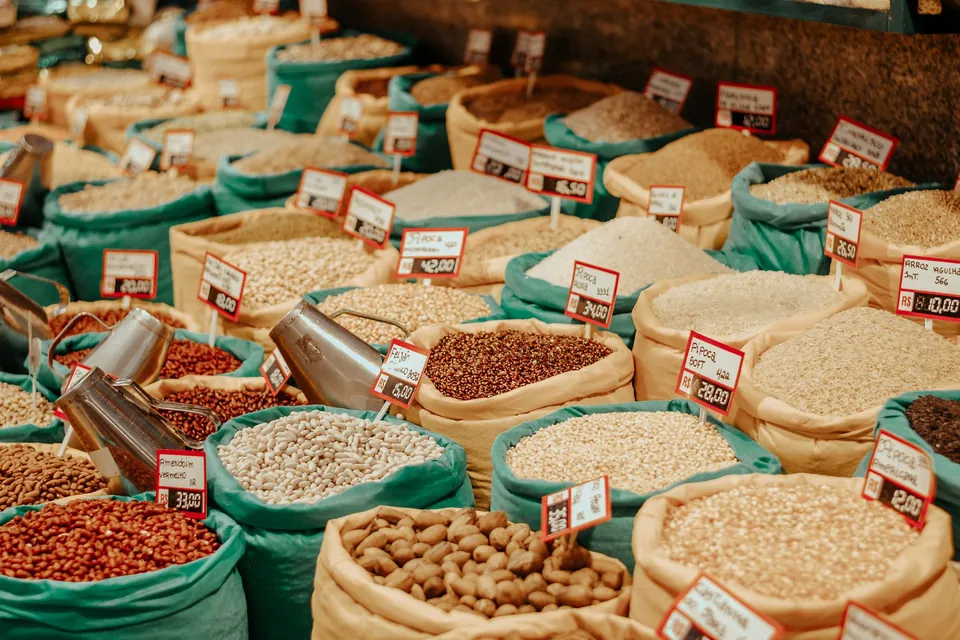
Zakat al-Fitr is a small charity every Muslim gives at the end of Ramadan: one sa', a measure of about four double handfuls, of staple food such as dates, rice or wheat, for each person in the household. The head of the household pays it for themselves and for everyone they support, including children. It has to reach the poor before the Eid prayer. Most scholars say it's given as food; the Hanafi school allows its value in money, and that's how most mosques in the West collect it, as a set amount per person.
In South Asian communities it's often called fitrana. It's separate from the yearly zakat on savings, and much simpler. Here's who pays, how much, when, and where the schools of law differ.
| Question | Short answer |
|---|---|
| Who pays? | Every Muslim who has more than a day's food for their family, on behalf of themselves and their dependants |
| How much? | One sa' of staple food per person, or its value in money in the Hanafi school |
| When? | Before the Eid al-Fitr prayer; a day or two early is fine, and some schools allow earlier in Ramadan |
| Who receives it? | The poor and needy |
Where it comes from
Ibn 'Umar described the rule exactly:
Allah's Messenger (ﷺ) enjoined the payment of one Sa' of dates or one Sa' of barley as Zakat-ul-Fitr on every Muslim slave or free, male or female, young or old, and he ordered that it be paid before the people went out to offer the `Id prayer.
Narrated by Ibn 'Umar.
Ibn 'Abbas explained what it's for:
The Messenger of Allah (ﷺ) prescribed the sadaqah (alms) relating to the breaking of the fast as a purification of the fasting from empty and obscene talk and as food for the poor. If anyone pays it before the prayer (of 'Id), it will be accepted as zakat. If anyone pays it after the prayer, that will be a sadaqah like other sadaqahs (alms).
Narrated by Ibn 'Abbas. Graded hasan (al-Albani).
So it does two jobs. It covers the small failings of your fast, the snapped comment or the idle chat, and it makes sure poor families have food on Eid, so the whole community can celebrate.
Who has to pay it
Zakat al-Fitr is due on "young or old", so it isn't only for adults who fasted. Children owe it too, and so do people who couldn't fast through illness. The person who pays is the one responsible for the household:
- For yourself, if you have food for you and your family for the day and night of Eid, with something left over. Most scholars set the threshold that low. The Hanafi school ties it to owning wealth above the zakat threshold, the nisab.
- For your children who don't have their own wealth. Parents pay for them, including a baby born before Eid.
- For your spouse. See the schools' views below.
- For others you support, such as an elderly parent who lives with you and depends on you.
If you became Muslim during Ramadan, you pay it for yourself this year, as long as you're Muslim at the time it becomes due. That's one of the first acts of worship many reverts do with their community, and it's a good one.
Many scholars also consider it recommended, though not required, to pay for a baby still in the womb.
How much: one sa' per person
A sa' is a measure of volume used in Madinah: four mudd, and a mudd is roughly what fits in two cupped hands. Since it's a volume, its weight depends on the food. For grains such as rice, it's usually given as somewhere around 2 to 3 kilograms. The Companions gave it from whatever people ate:
We used to give one Sa' of meal or one Sa' of barley or one Sa' of dates, or one Sa' of cottage cheese or one Sa' of Raisins (dried grapes) as Zakat-ul-Fitr.
Narrated by Abu Sa'id al-Khudri.
Today that means the staple of your country: rice, flour, dates, pasta. Multiply by the number of people you're paying for, and that's your Zakat al-Fitr.
If you pay in money, mosques and Muslim charities announce a figure per person each Ramadan, based on local food prices. Use the figure from your own mosque or a trusted local charity rather than one from another country; prices differ a lot. We don't publish a figure here because it changes every year.
Food or money?
This is the biggest practical difference between the schools.
When to pay it
The deadline is the Eid prayer. Pay it before, and it counts as Zakat al-Fitr. After the prayer, Ibn 'Abbas said, it's only ordinary charity. In practice that means:
- The best time is the morning of Eid, before the prayer.
- A day or two early is fine. The Companions did this, as Nafi' reported: "People used to give Sadaqat-ul-Fitr (even) a day or two before the `Id" (Sahih al-Bukhari 1511). If you give through a charity, give it earlier still, so they have time to get the food to families before Eid.
- If you missed it, pay it as soon as you can. It's still owed, and scholars say delaying it past Eid without an excuse is a sin to repent from. It doesn't just lapse.
Who receives it
Zakat al-Fitr is for the poor and needy, ideally in your own community. That's the point of "food for the poor" in the hadith: no one should go without on Eid. Many scholars allow it to go to any of the groups that can receive the main zakat, listed in Quran 9:60, while others, including the Maliki school, reserve it for the poor and needy. Either way, the poor come first.
You can't give it to the people you're already obliged to support, such as your own children or parents. Giving through your mosque or a trusted charity is the simplest way to make sure it reaches the right people on time.
How it differs from the yearly zakat
| Zakat al-Fitr | Zakat on wealth | |
|---|---|---|
| Amount | One sa' of food per person | 2.5% of savings above the nisab |
| When | Once, at the end of Ramadan | Once a lunar year on wealth you've held |
| Who pays | Almost every Muslim household | Only those whose wealth reaches the nisab |
| Paid for others? | Yes, for your dependants | No, each person on their own wealth |
If you have savings, read our guide to zakat explained for beginners, and use the zakat calculator to work out what you owe on your wealth. It's a separate calculation.
The free Fasting and Zakat course covers Ramadan, Zakat al-Fitr and zakat on wealth, step by step, with the evidence for each.
Questions people ask
What is Zakat al-Fitr?
A charity of one sa' of staple food for each person in your household, given at the end of Ramadan before the Eid prayer, to purify the fast and feed the poor (Sunan Abi Dawud 1609).
How much is Zakat al-Fitr per person?
One sa' of staple food, roughly 2 to 3 kg depending on the food. In money, use the per-person figure your local mosque or a trusted charity announces each year, since it follows local food prices.
When is the deadline for Zakat al-Fitr?
Before the Eid prayer. The Prophet ﷺ ordered it paid before people went out to pray (Sahih al-Bukhari 1503). A day or two early is fine.
Can I pay Zakat al-Fitr in cash?
The Hanafi school allows its value in money. The other three schools say it's paid in food. Many charities take cash and buy food for you, which works for both views.
Do I pay fitrana for my children?
Yes. Parents pay for children who don't have their own wealth, including babies born before Eid.
Is fitrana the same as zakat?
No. Fitrana is Zakat al-Fitr, a small fixed amount per person at the end of Ramadan. Zakat on wealth is 2.5% of savings above the nisab, paid once a lunar year.