

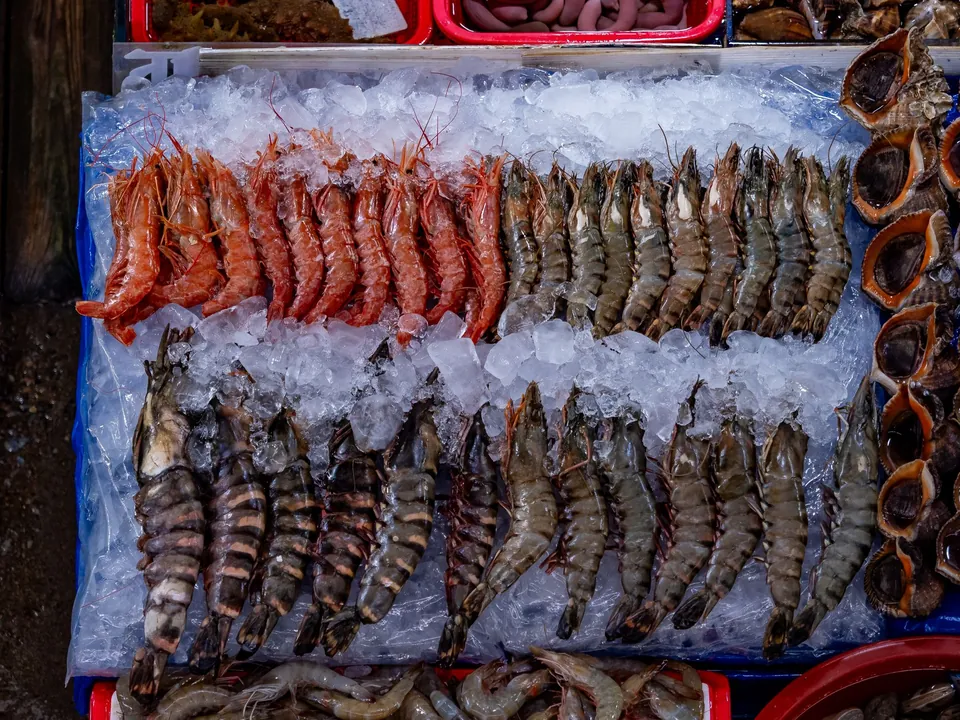
Yes, for most Muslims. The Quran says "lawful to you is game from the sea and its food" (5:96), and the Prophet ﷺ said of the sea that "what dies in it is lawful food." Based on that, the Maliki, Shafi'i and Hanbali schools hold that shrimp, prawns, lobster, squid, mussels and fish are all halal, with a few exceptions and some debate over creatures that also live on land, such as crabs. The Hanafi school is the exception: it allows fish only, and Hanafi scholars differ among themselves about shrimp. Seafood also doesn't need to be slaughtered.
So the answer depends partly on which school your community follows. Below is the evidence, each school's view stated fairly, and the thing that more often makes a seafood dish a problem: what it's cooked with.
The evidence: the Quran and the hadith
أُحِلَّ لَكُمْ صَيْدُ ٱلْبَحْرِ وَطَعَامُهُۥ مَتَـٰعًا لَّكُمْ وَلِلسَّيَّارَةِۖ وَحُرِّمَ عَلَيْكُمْ صَيْدُ ٱلْبَرِّ مَا دُمْتُمْ حُرُمًاۗ وَٱتَّقُوا۟ ٱللَّهَ ٱلَّذِىٓ إِلَيْهِ تُحْشَرُونَ ٩٦
Lawful to you is game from the sea and its food as provision for you and the travelers, but forbidden to you is game from the land as long as you are in the state of iḥrām. And fear Allāh to whom you will be gathered.
Translation: Saheeh International. Recitation: Mishary al-Afasy.
The ayah was revealed in the context of pilgrims in ihram, who can't hunt land animals, but its first part is general: catching and eating from the sea is lawful. Elsewhere Allah reminds us that He "subjected the sea for you to eat from it tender meat" (16:14).
The clearest hadith came from a practical question. Some sailors asked whether they could use seawater for wudu, since they only carried a little fresh water with them:
Its water is pure and what dies in it is lawful food.
Narrated by Abu Hurayrah. Graded sahih (al-Albani). Shortened.
Tirmidhi has the same hadith, graded sahih by Darussalam: "Its water is pure, and its dead are lawful" (Jami' at-Tirmidhi 69). The Prophet ﷺ answered their question and then told them something they hadn't asked, which scholars point to as an example of good teaching.
There's also a famous incident. A group of Companions on an expedition ran out of food and found a huge dead sea creature, al-'Anbar, washed up on the shore. They ate from it for weeks, and when they got back to Madinah and told the Prophet ﷺ, he said:
That was a provision which Allah had brought forth for you.
Narrated by Jabir. Shortened.
He then asked if they had any of the meat left, and Jabir says they sent him some and he ate it. So sea creatures don't need slaughtering, and even one found dead is lawful, according to most scholars.
What the four schools say
| Maliki | Shafi'i | Hanbali | Hanafi | |
|---|---|---|---|---|
| Fish | Halal | Halal | Halal | Halal |
| Shrimp and prawns | Halal | Halal | Halal | Differ: some allow, some don't |
| Lobster | Halal | Halal | Halal | Not allowed |
| Crab | Halal | Differ (see below) | Halal | Not allowed |
| Squid, octopus, mussels, oysters | Halal | Halal | Halal | Not allowed |
| Frogs, crocodiles | Discussed | Not allowed | Not allowed | Not allowed |
The Maliki school is the broadest: almost everything that lives only in water is halal. The Shafi'i and Hanbali schools also take the ayah and hadith generally, while excluding a few animals that live on land as well as in water, such as frogs and crocodiles. Crab is the one the Shafi'i school argues over most. Many classical Shafi'i texts list it with the animals that live on land as well as in water, which they don't allow, while some Shafi'i scholars today allow crabs that live only in the sea. If you follow the Shafi'i school, ask your imam.
If you're a new Muslim and haven't settled on a school, you don't need to solve this today. Follow what's taught where you learn your Islam. If you're eating with Muslim friends who avoid shrimp, don't order it in front of them as though it's no issue; and if they eat it, don't accuse them of eating haram. This is a real difference between scholars, not a case of one side ignoring the evidence.
The bigger issue: what it's cooked with
In practice, the prawn itself is rarely the problem. What's in the dish is. The Prophet ﷺ said:
Every intoxicant is Khamr and every intoxicant is forbidden.
Narrated by Ibn 'Umar. Shortened.
And a small amount doesn't make it acceptable: "If a large amount of anything causes intoxication, a small amount of it is prohibited" (Sunan Abi Dawud 3681, hasan sahih). Watch for these in seafood dishes:
- Wine and other alcohol in sauces: white wine in mussels and risotto, wine or brandy in bisques and lobster sauces, vodka sauce, beer batter for fish and chips.
- Japanese seasonings: mirin and sake are both rice wines and are common in sushi rice, teriyaki and glazes. Some halal-certified mirin substitutes exist; standard mirin contains alcohol.
- Shared fryers: a fish-and-chip shop or seafood restaurant may fry prawns in the same oil as pork or non-halal chicken. Many scholars say oil used for pork shouldn't be used for your food.
- Lard, bacon and stock: some chowders, paellas and gumbos include bacon, chorizo or pork stock.
- Imitation crab and processed seafood: check the label for wine or mirin.
People sometimes say the alcohol "cooks off". Cooking doesn't reliably remove all of it, and most scholars advise avoiding dishes made with wine or spirits whether or not they've been heated. When in doubt, ask the kitchen. A simple "Is there any wine, mirin, beer or pork in this?" usually gets a clear answer.
At the supermarket
Plain fish and seafood, raw or frozen, with nothing added, are halal without certification, because they don't need slaughter. Ready meals and sauces are different: read the ingredients for wine, gelatin from an unknown source and other additives. Our halal food guide for new Muslims has a list of ingredients to look out for and covers meat, which works very differently.
If you're eating with non-Muslim family, seafood is often an easy option, since a plain grilled fish needs no special supplier. Say Bismillah before you start, as with any meal; our page on the dua before and after eating has the rest. Ask them to leave the wine out of the sauce, or to cook yours separately. Most families are happy to help once they know.
Other animals people ask about
- Eel: it's a fish, so it's halal in all four schools.
- Shark and whale: halal for the majority, as sea creatures; the 'Anbar the Companions ate is usually identified as a whale. Hanafi scholars generally consider shark a fish.
- Seaweed: it's a plant, so it's halal, unless it's prepared with something that isn't.
- Caviar and fish roe: roe takes the ruling of the fish it comes from, so roe from a halal fish is halal.
Our free course Halal Food: A Beginner's Guide covers labels, meat and slaughter, seafood, alcohol in cooking and eating out, so you can shop and order with confidence.
Questions people ask
Can Muslims eat shrimp?
Yes, according to the Maliki, Shafi'i and Hanbali schools, based on Quran 5:96 and the hadith that the sea's dead are lawful. Hanafi scholars differ: some allow shrimp as a kind of fish, others don't. Ask your imam if you follow the Hanafi school.
Is shellfish halal?
For the majority of scholars, yes, including lobster, mussels and oysters, with some difference over crab. The Hanafi school allows only fish, so it doesn't permit shellfish.
Are prawns halal?
Prawns and shrimp are the same question. Most scholars say they're halal; within the Hanafi school there's a difference of opinion.
Is crab halal?
Yes, for the Maliki and Hanbali schools. Shafi'i scholars differ, since crabs can also live on land, and the Hanafi school doesn't allow it because it isn't a fish.
Does seafood need to be slaughtered to be halal?
No. The Prophet ﷺ said the sea's dead are lawful (Abu Dawud 83, Tirmidhi 69), so fish and seafood don't need slaughter.
Is seafood cooked in wine halal?
Most scholars say avoid it. Every intoxicant is forbidden, even in small amounts (Sahih Muslim 2003a, Abu Dawud 3681), and cooking doesn't reliably remove all the alcohol.