
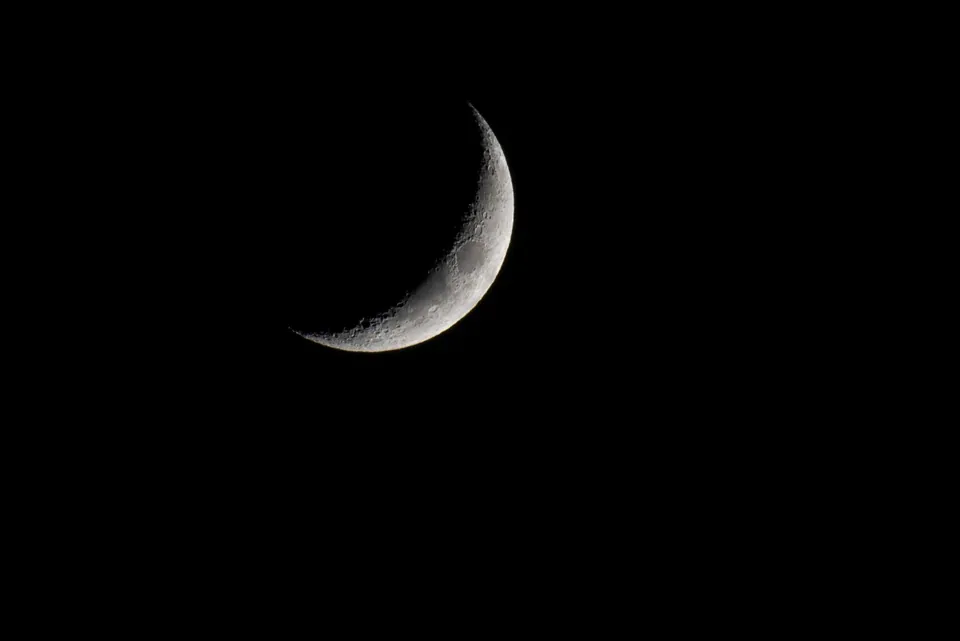
The twelve Islamic months, in order, are Muharram, Safar, Rabi' al-Awwal, Rabi' al-Akhir, Jumada al-Ula, Jumada al-Akhirah, Rajab, Sha'ban, Ramadan, Shawwal, Dhul-Qa'dah and Dhul-Hijjah. Each one starts when the new crescent moon is seen, so a month lasts 29 or 30 days and the whole year runs about 11 days shorter than the Gregorian one.
That's why Ramadan arrives earlier every year, and why your Muslim friends say "Eid is probably on Tuesday" instead of naming a date months ahead. Below you'll find the full list with the Arabic, what each name means, and what happens in each month, followed by the four sacred months and how the moon decides it all. If you only want today's date, our Islamic date today page shows it for wherever you are.
The 12 months at a glance
| # | Month | Arabic | What the name is usually taken to mean | Worth knowing |
|---|---|---|---|---|
| 1 | Muharram | مُحَرَّم | Forbidden, sacred | Sacred month; the Islamic new year; 'Ashura on the 10th |
| 2 | Safar | صَفَر | Empty, or yellow | No special acts of worship |
| 3 | Rabi' al-Awwal | رَبِيع الأَوَّل | The first spring | Most historians place the Prophet's ﷺ birth and death in this month |
| 4 | Rabi' al-Akhir (al-Thani) | رَبِيع الآخِر | The second spring | No special acts of worship |
| 5 | Jumada al-Ula | جُمَادَى الأُولَى | The first dry month | No special acts of worship |
| 6 | Jumada al-Akhirah | جُمَادَى الآخِرَة | The last dry month | No special acts of worship |
| 7 | Rajab | رَجَب | Honored, held in awe | Sacred month |
| 8 | Sha'ban | شَعْبَان | Spreading out | The Prophet ﷺ fasted more in it than in any other month besides Ramadan |
| 9 | Ramadan | رَمَضَان | Scorching heat | The month of fasting; Laylat al-Qadr |
| 10 | Shawwal | شَوَّال | Lifting, raising | Eid al-Fitr on the 1st; six optional fasts |
| 11 | Dhul-Qa'dah | ذُو القَعْدَة | The month of sitting (no fighting) | Sacred month |
| 12 | Dhul-Hijjah | ذُو الحِجَّة | The month of the pilgrimage | Sacred month; Hajj, the day of 'Arafah, Eid al-Adha |
A word on those meanings. The names are older than Islam, and the explanations come from the classical Arabic dictionaries, which sometimes give more than one. Ramadan is linked to ramad, intense heat; Jumada to water freezing or land drying out; Sha'ban to tribes spreading out to look for water. They tell you about the season the month fell in when it was named, not about anything that happens in it now, since the months have been moving around the solar year ever since.
You'll also see different spellings: Rabi' al-Thani and Rabi' al-Akhir are the same month, and Dhul-Qa'dah is sometimes written Dhu al-Qi'dah. Don't let that throw you.
Month by month: what happens when
1. Muharram
The year opens with a sacred month. The Prophet ﷺ called it "Allah's month" and singled it out for voluntary fasting:
The most excellent fast after Ramadan is God's month. al-Muharram, and the most excellent prayer after what is prescribed is prayer during the night.
Narrated by Abu Hurayrah.
Its tenth day is 'Ashura. When the Prophet ﷺ reached Madinah, he found the Jews fasting it in thanks for Musa's rescue from Pharaoh:
We have more claim over Moses than you." So, the Prophet fasted on that day and ordered (the Muslims) to fast (on that day).
Narrated by Ibn 'Abbas. Shortened.
Asked about the reward of that fast, he said it expiates the sins of the year before (Sahih Muslim 1162b). Many people fast the ninth as well. And 1 Muharram is New Year's Day, though the Prophet ﷺ didn't mark it with any special worship.
2 to 6. Safar to Jumada al-Akhirah
These five months have no fixed fasts or festivals. That's fine. Ordinary months are where most of your worship happens: the five prayers, Mondays and Thursdays if you like to fast, the morning and evening adhkar. You may hear that Safar is unlucky. Islam rejects that idea; the Prophet ﷺ said there's no bad omen in Safar (Sahih al-Bukhari 5707).
Rabi' al-Awwal stands out among them for history rather than ritual. Most biographers place the Prophet's ﷺ birth here, with the 12th the best-known date, though the exact day is debated. He arrived in Madinah on the Hijrah in this month, and he passed away in it too, in the year 11 AH.
7. Rajab
The second sacred month, sitting by itself in the middle of the year. The Isra' and Mi'raj, the Prophet's ﷺ night trip to Jerusalem and ascent through the heavens, is often dated to 27 Rajab, but the historians don't agree on the date, and there's no authentic hadith setting a special prayer or fast for that night.
8. Sha'ban
The warm-up for Ramadan. 'A'ishah said:
I never saw Allah's Messenger (ﷺ) fasting for a whole month except the month of Ramadan, and did not see him fasting in any month more than in the month of Sha'ban.
Narrated by 'A'ishah. Shortened.
If you're facing your first Ramadan, a few voluntary fasts in Sha'ban are a good way to find out how your body handles it. It's also when anyone with missed Ramadan fasts from last year rushes to make them up.
9. Ramadan
The month of fasting and the month the Quran was first revealed (2:185). Its last ten nights hold Laylat al-Qadr, the Night of Decree:
Search for the Night of Qadr in the odd nights of the last ten days of Ramadan.
Narrated by 'A'ishah.
Our Ramadan guide has the timetable and the practical side, and your first Ramadan as a new Muslim covers what to expect if this is your first one.
10. Shawwal
Eid al-Fitr falls on 1 Shawwal, the day after Ramadan ends. Fasting is not allowed on the day of Eid itself, but after it there's a well-known sunnah:
He who observed the fast of Ramadan and then followed it with six (fasts) of Shawwal. it would be as if he fasted perpetually.
Narrated by Abu Ayyub al-Ansari.
The six don't have to be in a row. See Eid al-Fitr 2027 for the expected date.
11 and 12. Dhul-Qa'dah and Dhul-Hijjah
Two sacred months back to back. Dhul-Hijjah is the month of Hajj, which runs from the 8th to the 13th. The 9th is the day of 'Arafah. For anyone not on Hajj, fasting it carries a huge reward: the Prophet ﷺ was asked about it and said it "expiates the sins of the preceding year and the coming year" (Sahih Muslim 1162b). The 10th is Eid al-Adha, the day of sacrifice; see Eid al-Adha 2027 for the expected date.
The four sacred months
Four of the twelve are called sacred (al-ashhur al-hurum). The Quran states it directly:
إِنَّ عِدَّةَ ٱلشُّهُورِ عِندَ ٱللَّهِ ٱثْنَا عَشَرَ شَهْرًا فِى كِتَـٰبِ ٱللَّهِ يَوْمَ خَلَقَ ٱلسَّمَـٰوَٰتِ وَٱلْأَرْضَ مِنْهَآ أَرْبَعَةٌ حُرُمٌۚ ذَٰلِكَ ٱلدِّينُ ٱلْقَيِّمُۚ فَلَا تَظْلِمُوا۟ فِيهِنَّ أَنفُسَكُمْۚ وَقَـٰتِلُوا۟ ٱلْمُشْرِكِينَ كَآفَّةً كَمَا يُقَـٰتِلُونَكُمْ كَآفَّةًۚ وَٱعْلَمُوٓا۟ أَنَّ ٱللَّهَ مَعَ ٱلْمُتَّقِينَ ٣٦
Indeed, the number of months with Allāh is twelve [lunar] months in the register of Allāh [from] the day He created the heavens and the earth; of these, four are sacred. That is the correct religion [i.e., way], so do not wrong yourselves during them. And fight against the disbelievers collectively as they fight against you collectively. And know that Allāh is with the righteous [who fear Him].
Translation: Saheeh International. Recitation: Mishary al-Afasy.
The Quran doesn't name the four, but the Prophet ﷺ did:
the year is twelve months, four of which are sacred. Three of them are in succession; Dhul-Qa'da, Dhul-Hijja and Al-Muharram, and (the fourth being) Rajab Mudar (named after the tribe of Mudar as they used to respect this month) which stands between Jumad (ath-thani) and Sha'ban.
Narrated by Abu Bakrah. Shortened.
So the sacred months are Muharram, Rajab, Dhul-Qa'dah and Dhul-Hijjah. The ayah says "do not wrong yourselves during them". In his tafsir of this verse, Ibn Kathir explains that a sin in these months is worse than the same sin in other months, and he reports from Ibn 'Abbas that the reward for good deeds in them is multiplied. Wrongdoing is still forbidden all year round. In practice, people treat them as a time to be more careful and to add a little more worship.
How the moon decides the dates
Every Islamic month starts with the sighting of the new crescent, the hilal, just after sunset. The Quran ties the crescents to timekeeping:
۞ يَسْـَٔلُونَكَ عَنِ ٱلْأَهِلَّةِۖ قُلْ هِىَ مَوَٰقِيتُ لِلنَّاسِ وَٱلْحَجِّۗ وَلَيْسَ ٱلْبِرُّ بِأَن تَأْتُوا۟ ٱلْبُيُوتَ مِن ظُهُورِهَا وَلَـٰكِنَّ ٱلْبِرَّ مَنِ ٱتَّقَىٰۗ وَأْتُوا۟ ٱلْبُيُوتَ مِنْ أَبْوَٰبِهَاۚ وَٱتَّقُوا۟ ٱللَّهَ لَعَلَّكُمْ تُفْلِحُونَ ١٨٩
They ask you, [O Muḥammad], about the crescent moons. Say, "They are measurements of time for the people and for ḥajj [pilgrimage]." And it is not righteousness to enter houses from the back, but righteousness is [in] one who fears Allāh. And enter houses from their doors. And fear Allāh that you may succeed.
Translation: Saheeh International. Recitation: Mishary al-Afasy.
And the Prophet ﷺ tied Ramadan to seeing it:
Start fasting on seeing the crescent (of Ramadan), and give up fasting on seeing the crescent (of Shawwal), and if the sky is overcast (and you cannot see it), complete thirty days of Sha'ban.
Narrated by Abu Hurayrah.
A lunar month is a little over 29 and a half days, so each month is either 29 or 30. Twelve of them add up to 354 or 355 days, about 11 days short of the solar year. That's the whole reason Ramadan comes about 11 days earlier each year, and why it passes through every season over roughly 33 years. Someone who fasts for decades will fast long summer days and short winter ones.
Where the Hijri year starts
The calendar counts from the Hijrah, the Prophet's ﷺ move from Makkah to Madinah in 622 CE. That's what the letters AH stand for: anno Hegirae, the year of the Hijrah. The Companions chose that event on purpose:
The Prophet's companions did not take as a starting date for the Muslim calendar, the day, the Prophet (ﷺ) had been sent as an Apostle or the day of his death, but the day of his arrival at Medina.
Narrated by Sahl ibn Sa'd.
The calendar was put into official use in the time of 'Umar ibn al-Khattab, and Muharram was kept as the first month even though the Hijrah itself took place in Rabi' al-Awwal. Days in the Islamic calendar also begin at sunset, not midnight, which is why the first Taraweeh prayer happens the night before the first fast.
Remembering the order
If you're trying to learn them, group them. Two pairs share a name: the two Rabi's and the two Jumadas. That leaves Muharram and Safar before them, then Rajab, Sha'ban, Ramadan and Shawwal after, then the two "Dhul" months to finish. Saying them aloud a few times in that order works better than staring at a list.
The Hijri calendar is also where a lot of new Muslims first feel the year turning differently. Your Ramadan, your Eids and your sacred months will be marked by the moon, not by the wall calendar at work. Our free Fasting and Zakat course walks through Ramadan, the voluntary fasts in this list and the zakat year that's counted in Hijri months too.
Questions people ask
What are the 12 Islamic months in order?
Muharram, Safar, Rabi' al-Awwal, Rabi' al-Akhir, Jumada al-Ula, Jumada al-Akhirah, Rajab, Sha'ban, Ramadan, Shawwal, Dhul-Qa'dah and Dhul-Hijjah.
What are the Islamic months in English?
They don't have English names. They're always used in their Arabic form, though their meanings translate roughly as sacred, empty, first spring, second spring, first dry month, last dry month, honored, spreading out, scorching heat, lifting, the month of sitting, and the month of pilgrimage.
Which are the four sacred months in Islam?
Muharram, Rajab, Dhul-Qa'dah and Dhul-Hijjah, as the Prophet ﷺ listed them in Sahih al-Bukhari 4662. The Quran mentions that there are four in Surah at-Tawbah 9:36.
What Islamic month is it now?
It changes with the moon, so check our Islamic date today page, which converts today's date for your location.
Why does Ramadan move every year?
The Islamic year follows the moon and is about 354 days long, roughly 11 days shorter than the solar year. So every Islamic month, Ramadan included, starts about 11 days earlier each Gregorian year.
What is the Hijri calendar?
It's the Islamic lunar calendar, counted from the Prophet's ﷺ Hijrah to Madinah in 622 CE. Years are marked AH, after the Hijrah.