When you visit a mosque for the first time, dress modestly, arrive a little before a prayer or in a quiet hour between prayers, take your shoes off at the entrance, and step in with your right foot saying Allahumma-ftah li abwaba rahmatik ("O Allah, open for me the doors of Your mercy"). If you have wudu, pray two short rak'ahs before you sit down. Then find a spot, sit, and when you're ready, ask for the imam and tell him you're new.
If you're anxious about it, and many new Muslims are, the rest of this guide walks you from planning the visit to walking back out.
Before you go
Pick the right time
For a first visit, a weekday is usually easier than Friday. The Friday prayer, Jumu'ah, is the busiest time of the week: the hall fills up, there's a sermon, and everyone leaves at once. It's worth going to, and our guide to how to pray Jummah explains it, but it's a lot for a first visit.
Quieter options are a weekday Dhuhr or Asr, when a smaller group prays, or the hour after a prayer when the building is calm. Maghrib, at sunset, often has a friendly crowd and is short. Check the mosque's website or social media for prayer times and opening hours; some smaller mosques lock up between prayers.
What to wear
Wear clean, loose clothes that cover you well. For men, that means at least trousers that cover the knees, ideally full-length, and a shirt. For women, long sleeves, a long skirt or loose trousers, and a scarf for your hair. Most mosques expect women to cover their hair inside the prayer hall, so bring one even if you don't wear it yet.
Wear clean socks without holes. You'll be in them the whole time. And avoid eating raw garlic or onion just before you go. The Prophet ﷺ was specific about this:
Whoever eats garlic or onion should keep away from our mosque or should remain in his house.
Narrated by Jabir ibn 'Abdullah. Shortened.
Wudu: before you leave, or there
If you can, make wudu at home before you go. It's one less new thing to work out in public. If you can't, almost every mosque has a wudu area with low taps and seats. Our guide to how to make wudu goes through it step by step.
Women's facilities
Most mosques have a separate entrance or area for women, but not all of them, and a few smaller mosques have no women's space at all. If you're a woman, check the website or call ahead and ask, "Do you have a women's prayer area, and which entrance should I use?" It's a normal question, and they'll be glad you asked.
At the door
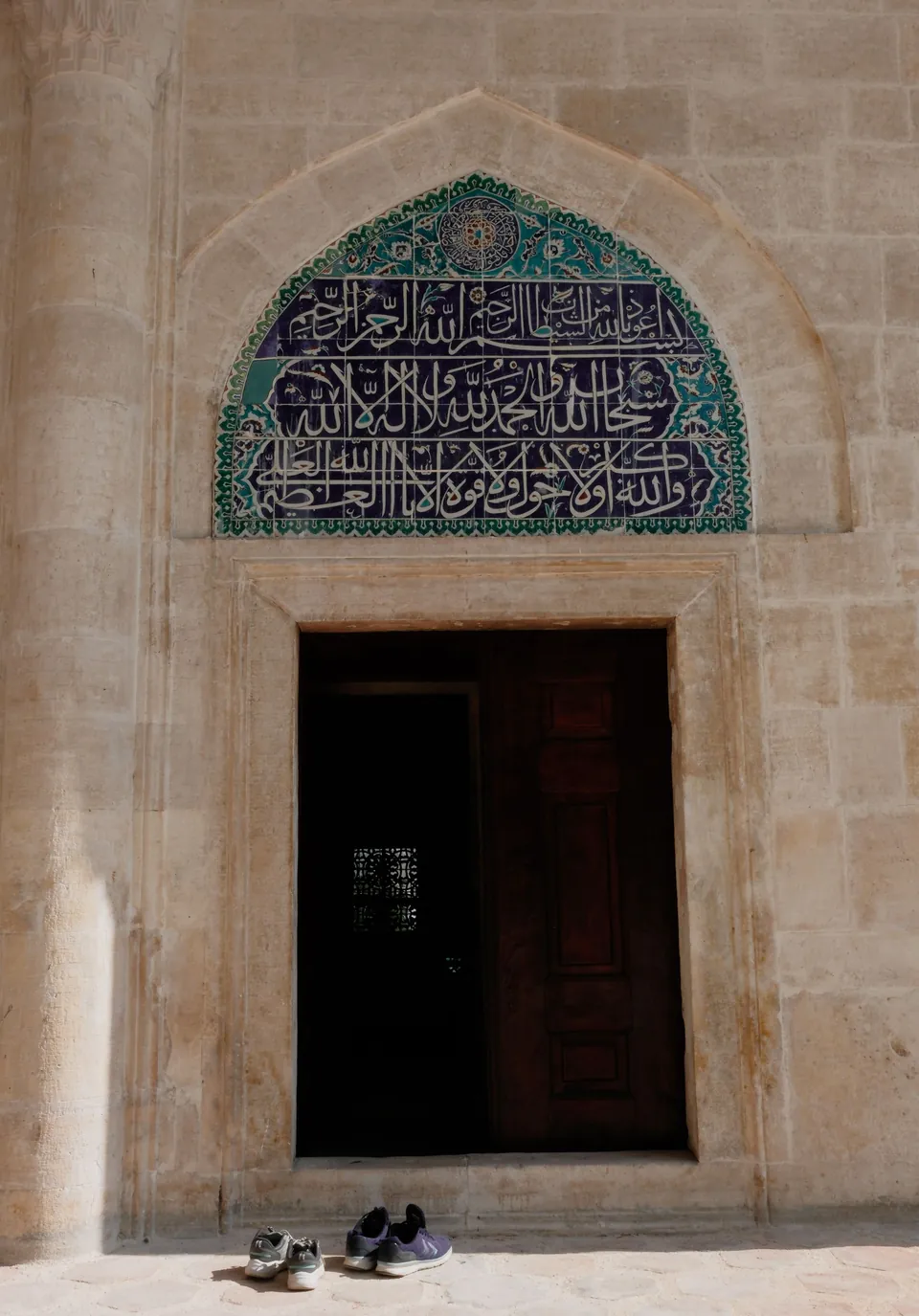
- Take your shoes off. There'll be shoe racks by the entrance or just inside. Put yours on a rack, not in the middle of the floor. Nobody walks on the prayer carpet in outdoor shoes.
- Step in with your right foot. The Prophet ﷺ liked to begin things from the right, and Muslims enter the mosque right foot first and leave left foot first.
- Say the du'a for entering. It's short, and it's below.
- Greet people. If someone's nearby, as-salamu 'alaykum (peace be upon you) is the greeting. The reply is wa 'alaykumus-salam.
The du'a for entering and leaving comes from this hadith:
When any one of you enters the mosque, he should say:" O Allah! open for me the doors of Thy mercy" ; and when he steps out he should say: 'O Allah! I beg of Thee Thy Grace.
اللَّهُمَّ افْتَحْ لِي أَبْوَابَ رَحْمَتِكَ
Narrated by Abu Usayd. Shortened.
Entering: Allahumma-ftah li abwaba rahmatik, "O Allah, open for me the doors of Your mercy."
Leaving: Allahumma inni as'aluka min fadlik, "O Allah, I ask You of Your bounty."
Two rak'ahs when you arrive
When you come into a mosque and you have wudu, the Sunnah is to pray two rak'ahs before sitting down. It's called tahiyyat al-masjid, the greeting of the mosque:
If anyone of you enters a mosque, he should pray two rak`at before sitting.
Narrated by Abu Qatadah al-Aslami.
It's an ordinary two-rak'ah prayer, prayed on your own. If you've only just started praying and don't feel ready, it's a sunnah, not a requirement, so it's fine to sit down. If the congregational prayer is about to start, you just join that instead.
Where to go and where to sit
Inside, the prayer hall faces the qibla, the direction of the Ka'bah in Makkah. You'll see a niche in the front wall, the mihrab, where the imam stands, and often a set of steps beside it, the minbar, where the Friday sermon is given.
- Between prayers, sit anywhere that's free. Many people sit against a wall or a pillar. You can read, make dhikr, or sit and take it in.
- Don't walk directly in front of someone who's praying. Go around behind them, or wait. If someone has put a small object in front of them as a marker, don't cross it.
- Keep your voice down, and put your phone on silent.
When the prayer starts
You'll hear the adhan, the call to prayer, and then a few minutes later the iqamah, a faster second call that means the prayer is starting now. People stand and form straight rows behind the imam, shoulder to shoulder, filling the front rows first.
If you know how to pray, join a row. Follow the imam: don't move before he does. If you're still learning, you can join and follow the people around you, which is one of the easiest ways to learn. Our step-by-step salah guide covers the movements, and if the words are the hard part, see how to pray before you know any Arabic.
If you'd rather watch the first time, sit at the back or to the side, out of the rows. Nobody will mind.
Why men and women pray in separate rows or rooms
In nearly every mosque, men and women pray in separate rows or in separate rooms. In the Prophet's ﷺ own mosque, men and women prayed in the same hall, with the men's rows in front and the women's rows behind. He said:
The best rows for men are the first rows, and the worst ones the last ones, and the best rows for women are the last ones and the worst ones for them are the first ones.
Narrated by Abu Hurairah.
The reason scholars give is keeping some distance between men and women in prayer. Prayer involves bowing and prostrating close to the people next to you, and separate rows mean everyone can concentrate on the prayer, not on who's beside them. It isn't about women being less welcome. The Prophet ﷺ told men not to stop women from coming:
Do not stop Allah's women-slaves from going to Allah's Mosques
Narrated by Ibn 'Umar. Shortened.
Today, many mosques use a separate room, a balcony or a partition rather than rows behind the men. The arrangement varies from mosque to mosque. If you're a woman and the space feels hard to find, ask at the entrance or send the mosque a message beforehand.
Introducing yourself to the imam
You don't have to talk to anyone on your first visit. But if you can manage it, meeting the imam or someone who runs things is the most useful thing you'll do there. Wait until the prayer and any dhikr afterwards are finished, then ask anyone, "Is the imam around?"
A short introduction is enough: "As-salamu 'alaykum. I'm new to Islam, I took my shahada recently, and this is my first time here." Most imams have had this conversation many times and will be pleased to meet you. Things worth asking:
- Is there a new Muslim class, circle or contact person?
- Is there someone who could check my Al-Fatihah or my prayer?
- Can I say my shahada here, if you haven't yet, or get a certificate?
- When are the quieter times to come?
If the first mosque you visit doesn't feel right, try another. Mosques differ a lot in size, language and atmosphere, and it's fine to look for one where you feel at home.
If you're too anxious to go in
This is very common. You might worry that you'll do something wrong, that people will stare, or that you don't look like you belong. A few things that help:
- Go with someone, even a Muslim friend who'll meet you at the door.
- Message the mosque first. Say you're new and ask if someone can show you around. Many mosques are happy to arrange this.
- Start small. Go in, pray two rak'ahs or just sit for ten minutes, and leave. That counts as a visit.
- Expect small mistakes. Everyone makes them. If someone corrects you, it's almost always meant kindly.
Mosques have always been open to people who were still finding their way. In the Prophet's ﷺ time, Thumamah ibn Uthal, a chief who wasn't Muslim, was brought to Madinah as a captive and held in the mosque itself. He spent days watching the Muslims there. When the Prophet ﷺ had him set free, this is what he did:
He went to a (garden of) date-palms near the mosque, took a bath and entered the mosque again and said, "None has the right to be worshipped but Allah and Muhammad is His Apostle" (i.e. he embraced Islam).
Narrated by Abu Hurairah. Shortened.
You belong in the mosque. It's as much yours as anyone's.
The free Salah course takes you from your very first prayer to praying with confidence at work, while travelling and in the mosque, including how to join a congregation and follow the imam. It's part of the New Muslim Foundations path. For a plan of everything to learn in your first month, see the new Muslim guide to the first 30 days.
Questions people ask
Can anyone visit a mosque?
Most mosques welcome visitors, Muslim or not, and many run open days and tours. Scholars differ on some details for non-Muslim visitors, so if you're bringing a non-Muslim friend or relative, ask the mosque first.
What is the dua for entering the masjid?
Allahumma-ftah li abwaba rahmatik, "O Allah, open for me the doors of Your mercy" (Sahih Muslim 713). On leaving: Allahumma inni as'aluka min fadlik, "O Allah, I ask You of Your bounty."
What should I wear to a mosque for the first time?
Clean, loose clothing that covers you well, and clean socks. Women should bring a scarf to cover their hair in the prayer hall.
What is mosque etiquette?
Shoes off at the door, enter with your right foot and say the du'a, pray two rak'ahs if you have wudu, keep your voice low, don't walk in front of someone praying, and avoid strong smells like raw garlic and onion.
Why do men and women sit separately in mosques?
So everyone can focus on the prayer. In the Prophet's ﷺ mosque, men prayed in front and women behind in the same hall. Today many mosques use a separate room or partition.
I'm too anxious to go to a mosque. What should I do?
Go at a quiet time, take a friend, or message the mosque first and ask for someone to meet you. A ten-minute visit counts. It gets easier after the first time.